
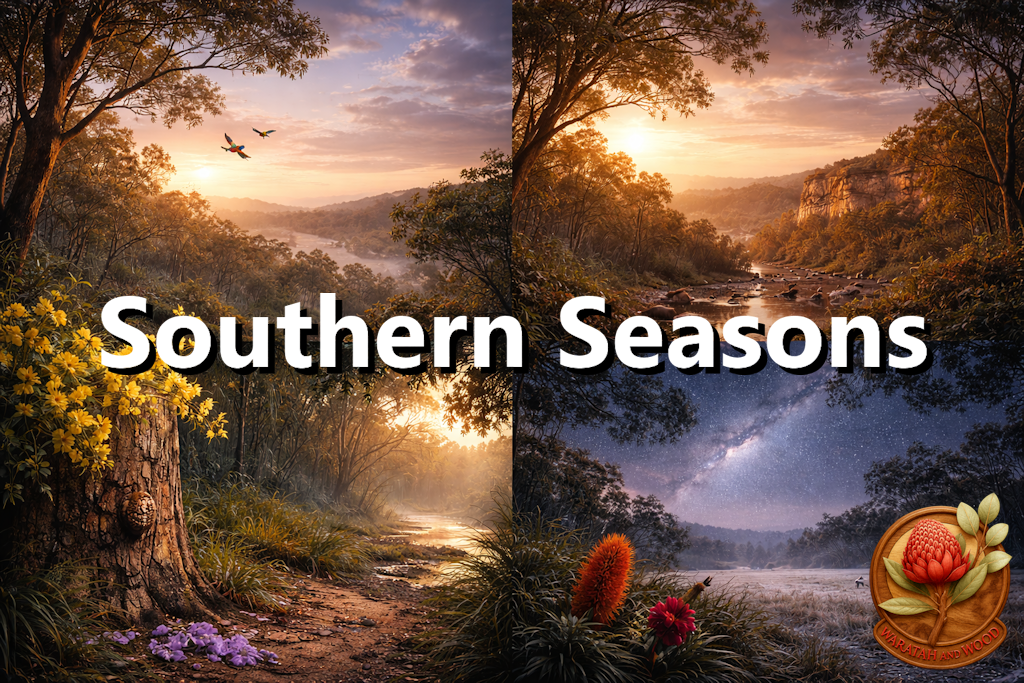
Australia has a way of marking time that doesn’t rely on marble walls or chapel roofs. The year turns instead in flashes of parrot wings, in eagles rising over warm sandstone, in the smell of rain settling into ochre earth. Southern Seasons was written as a reminder of that quieter, older language — the one every Australian learns simply by living here.
The song carries a chant-like heartbeat, moving between dawn and dusk, storm and dew, creek hush and coastal tide. It speaks of sacredness found in ordinary elements — wind, flame, gravity, constancy — and of how deeply those things shape who we become. This is not an institutional Australia, but a breathing one, woven from trees and sky and the steady turning of light.
In its verses the country shows up in full colour: wattle draped in morning beads, jacaranda dressed in violet streets, alpine winds circling Kosciuszko, northern wetlands humming with bird song. At the centre stands Uluru in its glowing accent, lyrebirds telling stories in mimicry, kangaroos calling across banksia flame. The landscape becomes the choir.
Southern Seasons doesn’t pretend the nation is perfect; it suggests something more honest — that we are part of a living wheel, not owners of it. The return chorus says it plainly:
I stand, I yield, I learn, I see —
the turning wheel lives here in me.
That line is an invitation to listeners everywhere to pause, look up into one shared southern sky, and feel themselves connected to the same cycle that has always turned across this continent. Australia speaks most clearly when we listen.
As the New Year settles into summer storms and long cobalt evenings, this song offers a simple truth: harmony in place of command, heart in step with land, barefoot grace beneath a vast and watching sky.
